Cooling large commercial and industrial spaces presents unique challenges. Facilities such as warehouses, manufacturing plants, and exhibition halls have high ceilings, open layouts, and large volumes of air to manage. Traditional air conditioning systems often struggle to cool these environments efficiently without consuming significant energy.
Rising electricity costs and sustainability goals are pushing facility managers to explore alternative cooling solutions. Evaporative cooling systems have emerged as an effective option for large spaces where conventional air conditioning may not be practical. Understanding the differences between these systems helps decision makers select the right solution for their facility.
What Is an Evaporative Cooling System
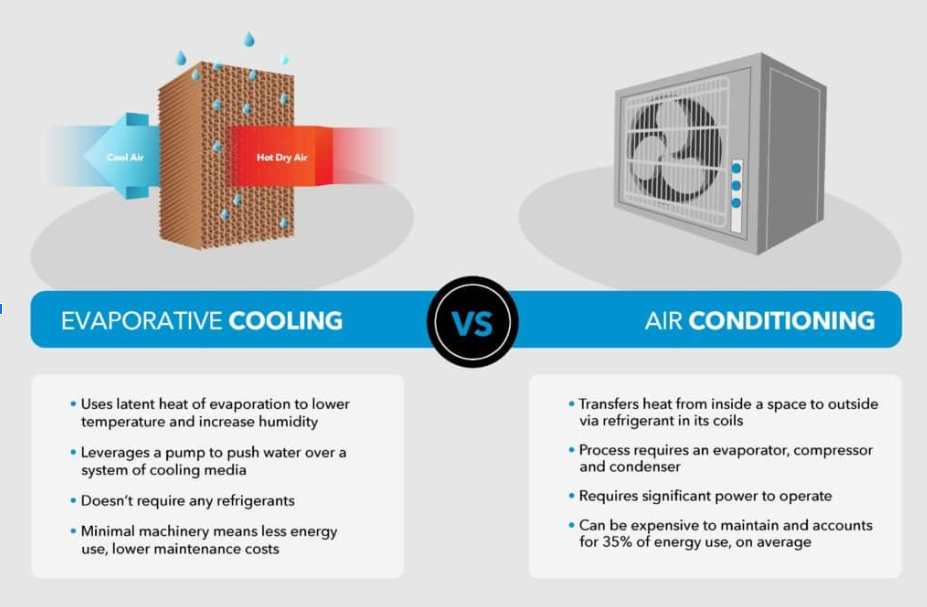
An evaporative cooling system is a cooling solution that uses the natural process of water evaporation to reduce air temperature. Warm outdoor air is drawn through water saturated cooling media, where heat is absorbed as water evaporates. The cooled air is then supplied into the space.
Unlike traditional air conditioning, evaporative cooling does not rely on refrigerants or compressors. This makes it a simpler and more energy efficient option for certain environments. Evaporative cooling systems are especially effective in large, well ventilated spaces.
How Traditional Air Conditioning Systems Work
Traditional air conditioning systems cool air using a refrigeration cycle. Warm indoor air passes over evaporator coils, where heat is absorbed by refrigerant. The cooled air is then circulated back into the space.
This process requires compressors, condensers, and significant electrical energy. In large facilities, maintaining uniform temperatures using traditional air conditioning can be costly. These systems are better suited for enclosed spaces with precise temperature control requirements.
Key Differences Between Evaporative Cooling Systems and Traditional Air Conditioning
Evaporative cooling systems and traditional air conditioning differ in design, operation, and performance. Understanding these differences helps clarify which system is more suitable for large spaces.
Key differences include:
- Evaporative cooling uses water evaporation, while air conditioning uses refrigeration
- Energy consumption is significantly lower in evaporative systems
- Evaporative cooling introduces fresh air continuously
- Traditional air conditioning recirculates indoor air
- Installation complexity is lower for evaporative systems
These differences directly impact operating costs and sustainability.
Cost Efficiency Comparison
Cost is a major factor when selecting a cooling system for large facilities. Evaporative cooling systems generally have lower initial and operating costs compared to traditional air conditioning.
Cost related considerations include:
- Lower installation costs for evaporative systems
- Reduced electricity consumption
- Minimal mechanical components
- Lower maintenance requirements
- Faster return on investment
In contrast, traditional air conditioning systems involve higher equipment and energy costs, especially at scale.
Energy Efficiency and Sustainability Benefits
Energy efficiency is one of the strongest advantages of evaporative cooling systems. These systems consume significantly less power because they do not use compressors or refrigerants. This results in lower electricity usage and reduced environmental impact.
Evaporative cooling supports sustainability goals by minimizing carbon emissions. It also aligns with green building practices focused on energy conservation. Traditional air conditioning systems, while effective, have a higher environmental footprint due to energy intensive operation.
Performance Benefits in Large Facilities
Evaporative cooling systems perform particularly well in large open areas. They provide continuous air movement and consistent cooling across wide spaces. This improves thermal comfort for occupants working in industrial environments.
Performance benefits include:
- Effective cooling in large open layouts
- Improved air circulation and ventilation
- Reduction of hot spots
- Enhanced comfort in dry and moderate climates
Traditional air conditioning may struggle to deliver uniform cooling in such spaces without high energy use.
Ideal Applications for Evaporative Cooling Systems
Industrial Applications
Evaporative cooling systems are widely used in industrial settings where large volumes of air must be cooled efficiently. These environments benefit from continuous fresh air and lower operating costs.
Common industrial applications include:
- Manufacturing plants
- Warehouses and distribution centers
- Production halls
- Assembly lines
These facilities prioritize airflow, comfort, and energy efficiency.
Commercial Applications
Commercial spaces with large open areas also benefit from evaporative cooling. These systems help maintain comfortable environments without excessive energy consumption.
Commercial applications include:
- Shopping malls
- Sports facilities
- Exhibition and convention centers
- Transportation terminals
In these settings, evaporative cooling enhances occupant comfort while controlling costs.
See also: How a Skincare Digital Marketing Agency Helps Beauty Brands Grow Online
When Traditional Air Conditioning Is More Suitable
Despite its advantages, evaporative cooling is not suitable for all environments. High humidity levels can reduce cooling effectiveness. Enclosed spaces requiring precise temperature and humidity control may benefit more from traditional air conditioning.
Traditional systems are preferred when:
- Humidity levels are consistently high
- Tight temperature control is required
- Spaces are fully enclosed
- Ventilation options are limited
Understanding these limitations helps ensure proper system selection.
Factors to Consider When Choosing Between the Two Systems
Choosing between evaporative cooling and traditional air conditioning requires careful evaluation of facility needs. Each system has distinct advantages depending on conditions and goals.
Important factors include:
- Climate and ambient humidity
- Size and layout of the space
- Energy efficiency objectives
- Budget constraints
- Long term operating costs
Evaluating these factors ensures an informed decision.
Integration of Evaporative Cooling with HVAC Systems
Evaporative cooling systems can be integrated with existing HVAC solutions to create hybrid cooling strategies. These approaches combine the strengths of both systems to optimize performance.
Hybrid solutions can reduce reliance on traditional air conditioning during favorable conditions. This improves overall efficiency and extends equipment life while maintaining comfort levels.
Future Trends in Large Space Cooling Solutions
As energy costs rise and sustainability becomes a priority, demand for low energy cooling solutions is increasing. Advances in evaporative cooling technology are improving efficiency and performance.
Modern systems offer better control, improved cooling media, and enhanced durability. These developments are driving wider adoption of evaporative cooling in large facilities worldwide.
Conclusion and Contact CTA
Evaporative cooling systems provide a cost effective, energy efficient, and sustainable alternative to traditional air conditioning for large spaces. Their ability to deliver fresh air cooling with lower energy consumption makes them ideal for industrial and commercial facilities. While traditional air conditioning remains suitable for certain applications, evaporative cooling offers clear advantages where space, ventilation, and efficiency are priorities.
To explore advanced evaporative cooling solutions designed for large facilities, connect with Desiccant Rotors International and learn how their expertise can help you achieve efficient and sustainable cooling performance.